
Query Ops
This crate provides a small set of query operators that can be used to implement a simple query-plan executor. The operators are: atom scan, semijoin, and natural join.
Public API
| Item | Type | Description |
|---|---|---|
scan_atom(&Table, &AtomPattern) -> Relation |
function | Scans the table under the pattern and returns a binding relation with one column per distinct variable in first-occurrence order. Literal positions and repeated variables filter rows during the scan. |
semijoin(&Relation, &Relation) -> Relation |
function | Returns the rows of left whose values on the columns shared with right also appear in right. The output column list is the same as left.columns. |
natural_join(&Relation, &Relation) -> Relation |
function | Returns every pair of left and right rows that agree on shared columns. Each output row holds the columns of left followed by the non-shared columns of right. |
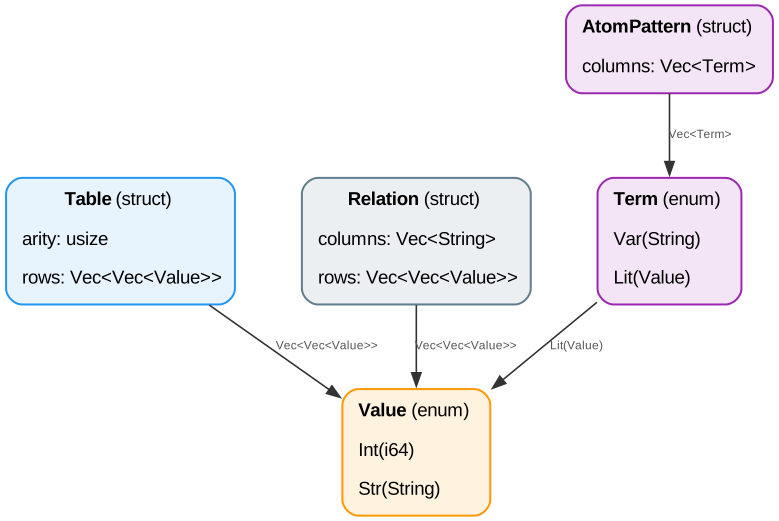
Table |
struct | Holds positional input rows of fixed arity and carries no column names. Construct it with Table::new(arity) or Table::from_rows(arity, rows). |
AtomPattern |
struct | Specifies, for each table column, either a variable to bind or a literal value to match. The pattern is a Vec<Term> whose length must equal the table's arity. |
Term |
enum | Represents one position of an AtomPattern. A term is either Var(String) to bind the cell to a named variable, or Lit(Value) to require the cell to equal a given value. |
Relation |
struct | Holds rows over named columns and is the type produced by every operator. Construct it with Relation::new(columns) or Relation::from_rows(columns, rows). Column names within a single relation must be unique. |
Value |
enum | Represents a single cell value stored in a Table or Relation. A value is either Int(i64) or Str(String). |
Example
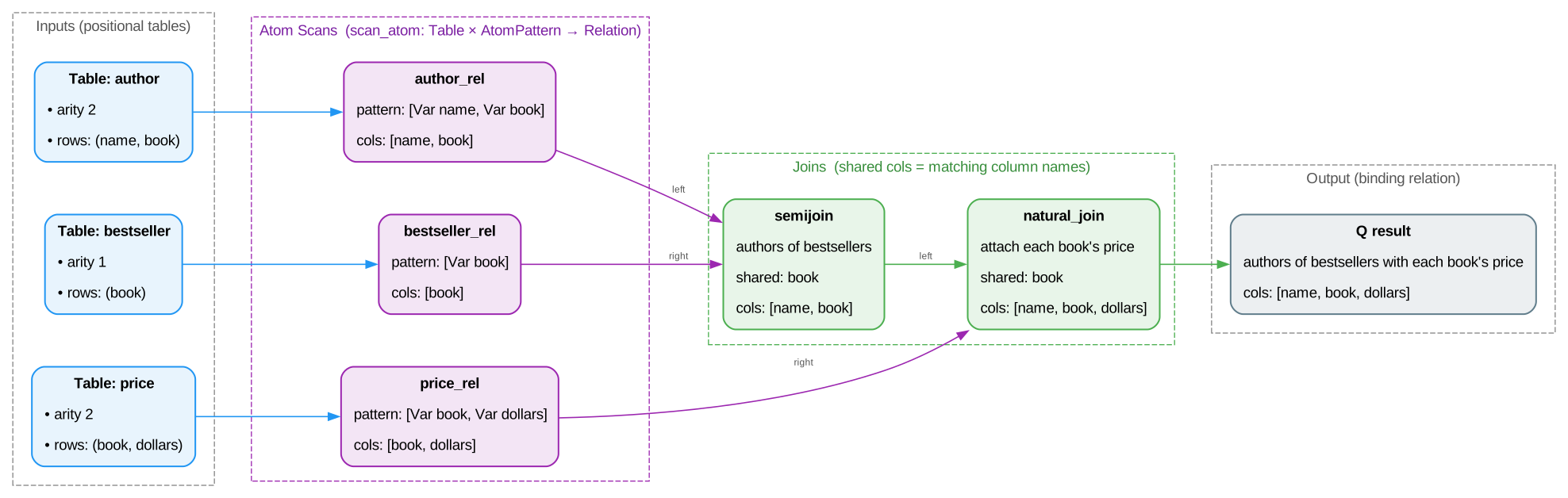
The rule below returns the authors of every bestseller along with the book's price. It uses all three operators:
scan_atomfor the three input tables,semijointo keep only authors of bestsellers,- and
natural_jointo attach each book's price.
Q(name, book, dollars) :- author(name, book), bestseller(book), price(book, dollars).
use query_ops::atom::{AtomPattern, Term, scan_atom};
use query_ops::join::{natural_join, semijoin};
use query_ops::table::Table;
use query_ops::value::Value;

fn s(x: &str) -> Value {
    Value::Str(x.to_string())
}
fn i(x: i64) -> Value {
    Value::Int(x)
}

fn main() {
    let author = Table::from_rows(
        2,
        vec![
            vec![s("Alice"), s("Foo")],
            vec![s("Bob"), s("Bar")],
            vec![s("Alice"), s("Baz")],
            vec![s("Carol"), s("Qux")],
        ],
    );
    let bestseller = Table::from_rows(1, vec![vec![s("Foo")], vec![s("Baz")]]);
    let price = Table::from_rows(
        2,
        vec![
            vec![s("Foo"), i(25)],
            vec![s("Bar"), i(15)],
            vec![s("Baz"), i(30)],
            vec![s("Qux"), i(20)],
        ],
    );

    let author_rel = scan_atom(
        &author,
        &AtomPattern {
            columns: vec![Term::Var("name".to_string()), Term::Var("book".to_string())],
        },
    );
    let bestseller_rel = scan_atom(
        &bestseller,
        &AtomPattern {
            columns: vec![Term::Var("book".to_string())],
        },
    );
    let price_rel = scan_atom(
        &price,
        &AtomPattern {
            columns: vec![Term::Var("book".to_string()), Term::Var("dollars".to_string())],
        },
    );

    let authors_of_bestsellers = semijoin(&author_rel, &bestseller_rel);
    let result = natural_join(&authors_of_bestsellers, &price_rel);

    assert_eq!(
        result.columns,
        vec!["name".to_string(), "book".to_string(), "dollars".to_string()],
    );
    assert_eq!(
        result.rows,
        vec![
            vec![s("Alice"), s("Foo"), i(25)],
            vec![s("Alice"), s("Baz"), i(30)],
        ],
    );
}
How it works:
Test
cargo test -p query-ops